
Untouchables: My Family's Triumphant Escape from India's Caste System ★★★★★
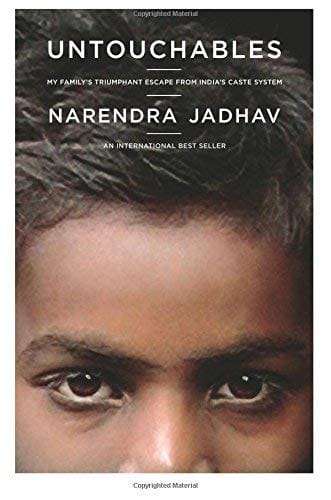
Regardless of the title, this post might venture beyond the realms of a book review and try to scratch some memories from my recent past. Simon and Schruster sent me couple of books by Indian authors last fall and although I wasn't obliged to review them; I ventured down that path for the sake of my readers and others who might want to buy the books. I wasn't overtly impressed by Vikas Swarup's Q&A although I recommended it for a quick Sunday afternoon read. However, Untouchables by Narendra Jadhav is in a different class altogether. I had completed reading the book couple of months back but never got around to writing about it. But the impact of the book is such that I am writing this without even going back to the book to refresh my memory.
The author is presently a chief economist at the Reserve Bank of India and has held several eminent positions in international organizations including the World Bank. Going by his resume, you might assume that he might have hailed from a distinguished family who funded his education and the 'old boys network' soon catapulted him to greater fame. On the contrary, Untouchables takes you back a generation in Dr. Jadhav's life carefully documenting his parent's memoirs. Pieced together from his parents' narrations, the tale not only gives you a glimpse of India's dark history of caste discrimination but also remains highly optimistic on the ultimate triumph of hard work, determination, and intolerance toward injustice. Admittedly, the book might have lost some of its brilliance when it was translated from Marathi to English but it still remains an inspiring read.
Damu and Soni, as his parents were lovingly called by their near and dear ones take turns to narrate their life story shackled by the stigma of untouchability. The book begins with a intensely horrific tale of the plight of Mahars in Damu's village and the extent to which both the untouchables and the upper castes enjoined to keep the distance between people constant throughout the ages. With stories this powerful and facts this blatant, I wonder how we could harp on the glorious Indian heritage and tradition. People often justified these class discriminations by emphasizing on the functionary roles of people in a society. But such stagnant roles led to complacency and with the evolving times, functions of an individual within a society often intermingled.
Resistance to change was often the strongest from sections of the society who had gotten used to the power that culture and traditions had conferred upon them. As Dr. Jadhav's book shows, efforts at trying to break free from societal bonds and herald in a changed often met with indignation and more often, violent suppression from the oppressors and quiet acquiesce and subsequent apathy from the oppressed class. As Dr. Jadhav's meteoric rise through academic excellence proves, the subjugation of the oppressed class of untouchables lay in the continued denial of opportunity; even when the untouchables expressed a wish to rise from their status quo, their wishes were immediately squelched.
Dr. Ambedkar, an early success story from the untouchable strata gave plenty of his people confidence that things need not be the same always and he was rightly their beacon of hope. He could easily qualify as the Martin Luther King for the untouchables in India. He opposed Gandhi's epithet for the untouchables - Harijan as he wanted equal and not special status for his people. He would never have believed in the Mandal Commission recommendations that brought the issue on the forefront in the early nineties.
As you might have guessed, Dr. Jadhav's father was heavily influenced by Dr. Ambedkar and hearing his stories of the renowned leader also changed my opinion toward him. At the root was the struggle for equal right which is an inalienable right to any individual born on this planet. Unfortunately, the truth is not always this rosy. Even the most open and democratic society, the United States refused rights to its black citizens right uptil mid-sixties; almost 200 years after its independence. And untouchables talks about the time before India was independent when even the British considered it in their best interests to keep the Indian society segregated and we with out irrational prejudices played right into their hands. Untouchables is peppered with wonderful pithy stories of the struggle against injustice toward lower classes.
The book is not only a reflection on Indian society as it existed but an important part of our history too. The book concludes fantastically with an afterword by Dr. Jadhav's daughter who was born and brought up in the United States -- far from the discrimination that her grandparents faced. Yet traces of the wounds persist if you read between the lines but the good part is that, there is hope for change. The lesson is that you just have to follow your inner voice and express your protest; someone out there is definitely listening.
If you might wonder that Untouchables is a tale from India's dark ages and part of history that we have left behind, then you are mistaken. Pick up the nearest newspaper and skim through its pages. I bet you would definitely find a couple of stories that link violence to denial of justice. If you think that sitting in cosmopolitan towns like Bombay, Delhi, Chennai, Bangalore, etc. you are far from the injustices meted out to lower classes, then you are mistaken once again. No one says it but the undercurrents of caste discriminations still persist even among the so-called educated class.
If you are interested, I have had a personal brush with such blatant discrimination back in the days when I wore rose-tinted glasses that saw an Indian society bereft of any form of discrimination. I had never seen or experienced any form of discrimination almost right until I graduated from my undergrad college. I was involved romantically with one of my juniors who after an extended period of yes-no-yes-maybe finally acknowledged our relationship. But somewhere under that indecisive persona was a niggling fear that she took ages to come out with. Her reason for indecisiveness - her parents would never accept her relationship with a non-Brahmin. I had to make sure that I had heard it correct. My parents had always brought us up without pretensions toward our caste or community; rather we keep our distance from it and we weren't even one of 'those feared untouchables'.
On the contrary, we were only one rung lower on the Indian social hierarchy. Caste was never a factor in our interactions with the people we met and my parents were held in the highest regard in our town (they still are!). At the risk of sounding pompous, any typical Indian family in the town would have given an arm and a leg to be associated with our family but thankfully my parents were modest and never quite flaunted that fact.
So when I faced this out-of-the-blue unreal discrimination from some family that I had previously never interacted with, I knew I had to meet them. They were educated people for crying out loud and I thought I could make them see the light. But alas, after meeting them I was disappointed (and partly sorry for them) to see them still stuck in the dark ages. Upon questioning them directly, they had no logical answer for their prejudice and they even had the nerve to say that it would have been ok even if I was a deshatha Brahman (seemingly one rank lower among the Brahmins).
Gosh! I was getting a first hand lesson in Indian hypocrisy. It didn't end there. Her mom went to the extent of saying that, she wouldn't mind a non-Brahmin daughter-in-law because; hear this; she would be absorbed within their fold. Gosh! I couldn't believe my ears. Before I said anything insulting and degraded myself, I took their leave. My parents were rightly peeved as well because they had brought up their children in a seemingly fair and just society and judged people on their moral uprightness and dedication toward education; not on superfluous factors like caste. Thankfully my relationship with that girlfriend died a quick death and even to this day, I do not regret it one bit. I could never have fitted in with such blatant blind prejudice and thank my stars that it was revealed before things got serious.
I bet each one of us has an Untouchables tale even if it isn't as heart wrenching or serious as Dr. Jadhav's tale. He was given a new world of opportunity because his parents stood up to injustice and refused to give in to society's dogma. If you have lived in oppressing regimes, make sure your children don't. Dr. Jadhav soon reached the pinnacle of success and fulfilled his potential that otherwise would have remained stifled.
This book also holds a lesson for those who consider economic success as compensation for individual freedom and liberty e.g. China. People are not successful in spite of social discrimination but despite it. Their success is only an indicator of the latent potential of the rest of them. Imagine the possibilities.
Member discussion