
The Secret of Secrets ★★★☆☆

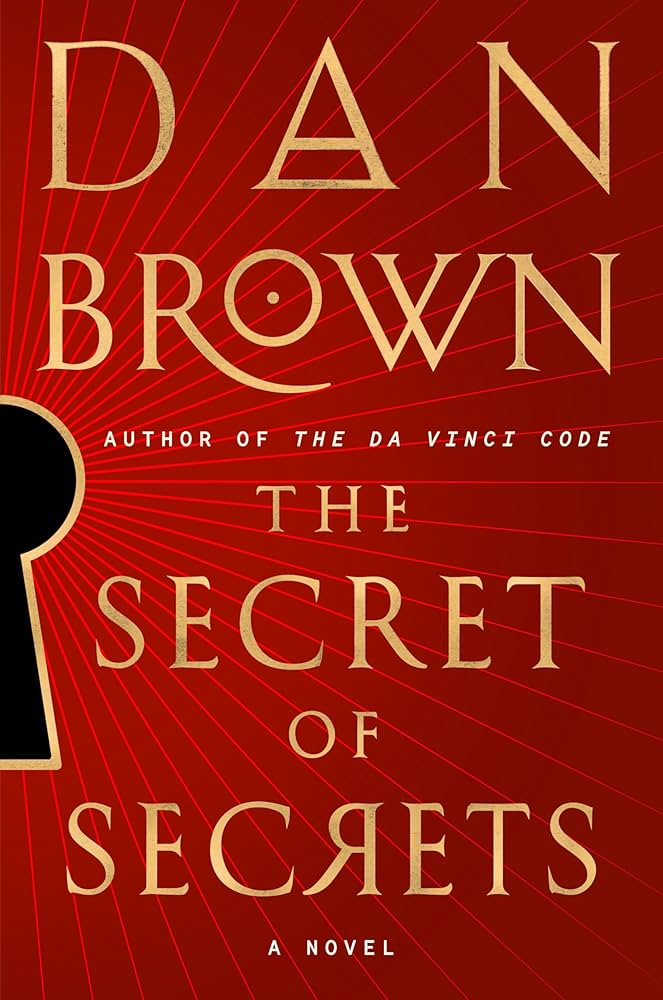
Dan Brown seems to have lost the art of making you turn the pages and with near 700 pages, this was the wrong book for him to start. So much exposition than plot. The twist is one of those most often explored ones so it doesn't surprise.
The nonlocal consciousness reminded me of Pluribus and as usual, it's tempting to want to believe.
- Format: 688 pages, Kindle Edition
- Published: September 9, 2025 by Doubleday
- ISBN: 9780385546928 (ISBN10: 0385546920)
- ASIN: B0DTT5LV77
- Language: English
Robert Langdon, esteemed professor of symbology, travels to Prague to attend a groundbreaking lecture by Katherine Solomon—a prominent noetic scientist with whom he has recently begun a relationship. Katherine is on the verge of publishing an explosive book that contains startling discoveries about the nature of human consciousness and threatens to disrupt centuries of established belief. But a brutal murder catapults the trip into chaos, and Katherine suddenly disappears along with her manuscript.
Langdon finds himself targeted by a powerful organization and hunted by a chilling assailant sprung from Prague’s most ancient mythology. As the plot expands into London and New York, Langdon desperately searches for Katherine . . . and for answers. In a thrilling race through the dual worlds of futuristic science and mystical lore, he uncovers a shocking truth about a secret project that will forever change the way we think about the human mind.
Notable Highlights
The afterlife is a shared delusion…created to make our actual life bearable. [loc. 224]
it actually had been a Czech writer—Karel čapek—who had coined the term “robot” for the very first time in a play he wrote in 1920. [loc. 7169]
“Fear makes us selfish,” Katherine said. “The more we fear death, the more we cling to ourselves, our belongings, our safe spaces…to that which is familiar. We exhibit increased nationalism, racism, and religious intolerance. We flout authority, ignore social mores, steal from others to provide for ourselves, and become more materialistic. We even abandon our feelings of environmental responsibility because we sense the planet is a lost cause and we’re all doomed anyway.” [loc. 9644]
The most important point in the research, however, shows that those who do not fear death, for whatever reason, tend to exhibit behavior that is more benevolent, accepting of others, cooperative, and caring about the environment. [loc. 9653]
“Robert, when you see someone glued to a phone, you see a person ignoring this world—rather than a person engrossed in another world…a world that, like this one, is made up of communities, friends, beauty, horror, love, conflict, right and wrong. It’s all there. The online world is not so different from our world…except for one stark difference.” Katherine smiled. “It’s nonlocal.” [loc. 9796]
The spiked halo adorning America’s Statue of Liberty was the same ornament that had crowned enlightened minds for millennia. The seven spikes, each over nine feet long, were said to symbolize the rays of enlightenment that would radiate outward from this young country and illuminate all seven continents. It’s the precise opposite, Katherine believed, seeing them as rays of enlightenment that flowed inward…representing the stream of cultures, languages, and ideas from the seven continents, all coursing into the melting pot that was the mind of America. This nation, after all, had been created as a kind of receiver, pulling in disparate souls from around the world, all of them flowing inward toward a shared experience. [loc. 10031]
Member discussion