
The Ministry of Utmost Happiness ★★★☆☆
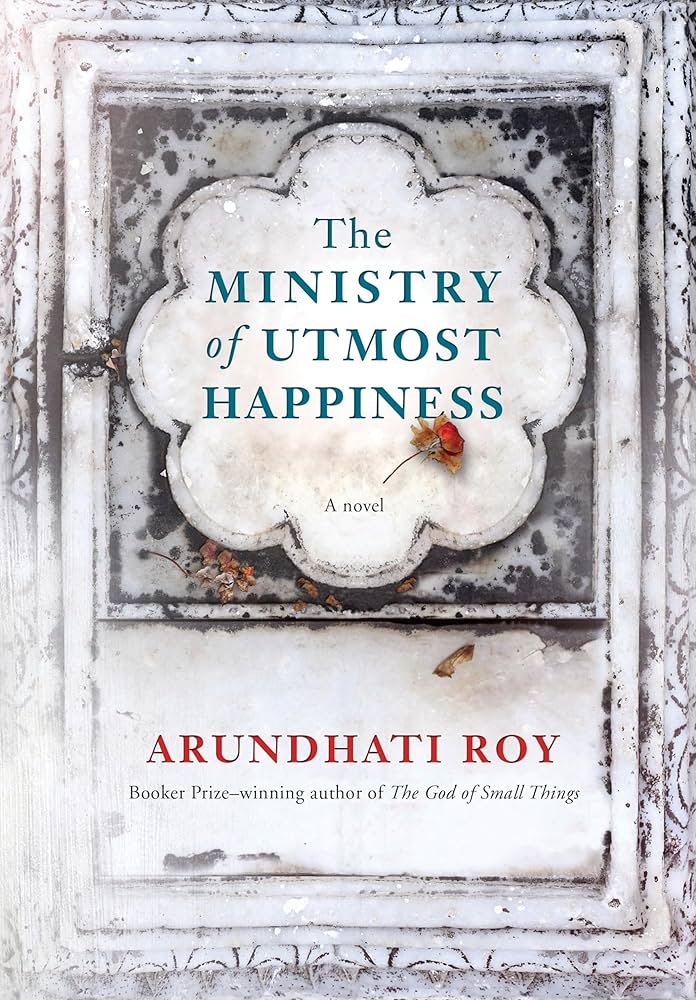
Roy writes like a dream and her prose is sometimes literally poetry. You cannot best her when she's at her evocative best. But this novel felt like a non-fiction account that's disguised as fiction. She has strong (and admirable) opinions about India's domestic affairs and as a longform essay, it's perfect. But in her effort to put out her next novel, she seemed to be in a haste although it seems it was a work in progress for a while. There are perhaps 2-3 books in here which by themselves would've been wonderful to savor.
- Format: 465 pages, Kindle Edition
- Published: June 6, 2017 by Knopf
- ISBN: 9781524733162 (ISBN10: 1524733164)
- ASIN: B01NBZXMTT
- Language: English
The Ministry of Utmost Happiness takes us on an intimate journey of many years across the Indian subcontinent, from the cramped neighborhoods of Old Delhi and the roads of the new city, to the mountains and valleys of Kashmir and beyond, where war is peace and peace is war.
The engine of Roy's story is a hijra (India's third gender) named Anjum, and the story begins with her unrolling a threadbare Persian carpet in a city graveyard she calls home. Anjum's charisma draws a vibrant assemblage of outcasts to join her--other hijras, Kashmiri freedom fighters, activists, orphans, low-caste Hindus and Muslims, and a host of animals. Anjum's home is a place where the formerly unwanted embrace each other's true selves.
We encounter the odd, unforgettable Tilo and the men who loved her, including Musa, sweetheart and ex-sweetheart, lover and ex-lover. Their fates are as entwined as their arms used to be and always will be. We meet Tilo’s landlord, a former suitor, now an intelligence officer posted to Kabul, and then we meet the two Miss Jebeens. The first is a child born in Srinagar and buried in its overcrowded Martyrs’ Graveyard. The second is found at midnight, abandoned on a concrete sidewalk in the heart of New Delhi.
As this ravishing, deeply humane novel braids these lives together, it reinvents what a novel can do and can be. The Ministry of Utmost Happiness demonstrates on every page Arundhati Roy’s storytelling gifts.
Notable Highlights
The saffron men sheathed their swords, laid down their tridents and returned meekly to their working lives, answering bells, obeying orders, beating their wives and biding their time until their next bloody outing. [loc. 989]
Fiercely competitive TV channels covered the story of the breaking city as “Breaking News.” Nobody pointed out the irony. They unleashed their untrained, but excellent-looking, young reporters, who spread across the city like a rash, asking urgent, empty questions; they asked the poor what it was like to be poor, the hungry what it was like to be hungry, the homeless what it was like to be homeless. [loc. 1435]
And people (who counted as people) said to one another, “You don’t have to go abroad for shopping any more. Imported things are available here now. See, like Bombay is our New York, Delhi is our Washington and Kashmir is our Switzerland. It’s like really like saala fantastic yaar.” [loc. 1444]
Normality in our part of the world is a bit like a boiled egg: its humdrum surface conceals at its heart a yolk of egregious violence. It is our constant anxiety about that violence, our memory of its past labors and our dread of its future manifestations, that lays down the rules for how a people as complex and as diverse as we are continue to coexist—continue to live together, tolerate each other and, from time to time, murder one another. As long as the center holds, as long as the yolk doesn’t run, we’ll be fine. In moments of crisis it helps to take the long view. [loc. 2153]
She remembered reading somewhere that even after people died, their hair and nails kept growing. Like starlight, traveling through the universe long after the stars themselves had died. Like cities. Fizzy, effervescent, simulating the illusion of life while the planet they had plundered died around them. [loc. 3046]
The sullen city was wide awake but feigning sleep. Empty streets, closed markets, shuttered shops and locked houses slid past the jeep’s slit windows—“death windows,” local people called them, because what peered out of them were either soldiers’ guns or informers’ eyes. [loc. 3287]
She had lost the ability to keep her discrete worlds discrete—a skill that many consider to be the cornerstone of sanity. The traffic inside her head seemed to have stopped believing in traffic lights. The result was incessant noise, a few bad crashes and eventually gridlock. [loc. 3314]
Kashmir was one of the few places in the world where a fair-skinned people had been ruled by a darker-skinned one. That inversion imbued appalling slurs with a kind of righteousness. [loc. 4513]
He referred to himself as Jannat Express. And if he was speaking English (which usually meant he was drunk), he translated that as Paradise Express. One of his legendary lines was: Dekho mian, mein Bharat Sarkar ka lund hoon, aur mera kaam hai chodna. [loc. 4795]
Harried doctors and nurses picked their way through the chaos. It was like a wartime ward. Except that in Delhi there was no war other than the usual one—the war of the rich against the poor. [loc. 5632]
The stupidification of the mainland was picking up speed at an unprecedented rate, and it didn’t even need a military occupation. [loc. 5648]
Member discussion