
The End of Trauma: How the New Science of Resilience Is Changing How We Think About PTSD ★★★★☆
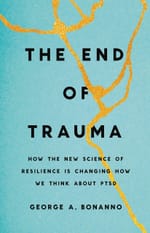

- Format: 336 pages, Hardcover
- Published: September 7, 2021, by Basic Books
- ISBN9781541674363 (ISBN10: 1541674367)
- ASIN1541674367
- LanguageEnglish
I heard of this book by George Bonanno on the Hidden Brain podcast. He challenges the widely perceived notion that all trauma causes PTSD in all people. While not diminishing actual trauma victims who suffer post-traumatic stress, he emphasizes through research that not all such stress leads to a disorder. For one, PTSD is surprisingly uncommon considering the multiple traumatic incidents many of us face in today's world, and people are also unexpectedly resilient and tend to cope not easily yet satisfactorily eventually. So what gives?
I found his arguments convincing because he advocates for a resiliency mindset, which is similar to a growth mindset that I've worked in and researched. He lays down three essential factors that foster a resiliency mindset through a coping process that kickstart the flexibility sequence:
- Optimism about the future,
- Confidence in our ability to cope, and
- a willingness to think about a threat as a challenge.
He makes a case by narrating several cases where a person has undergone a severe trauma, ranging from being in one of the towers on 9/11 to being part of a horrific road accident that led to amputation, to a mugging in a park at night. These three characteristics, not necessarily in any particular order and not always to the same degree, define resilient individuals. Hence, we see people who emerged from the horrors of the Holocaust (think Elie Wiesel) go on to live long, productive lives. Of course, it leaves a mark, but not always for the worse.
The book serves as a valuable instruction manual for coping with today's world. I've always considered myself a pissed off optimist. Yes, I'm angry, but I'm also confident that eventually the future will be better. It won't be easy or even linear. Things will get bad, then slightly better, and then worse before eventually emerging in a new reality that's better than our past. That belief is the first step in gaining confidence in our ability to cope.
Millions of people have lived under fascism and brutal regimes, but many of them coped. They kept trudging along in the hope that things would be better. Finally, it's not just about believing in the inevitability of change for the better but also about treating threats as a challenge rather than an overwhelming force that leaves you feeling helpless.
Of course, the book isn't perfect. It's less about the 'end of trauma' and more about 'dealing with trauma so that you aren't left scarred for life'. Also, not all types of trauma are the same. A child being sexually abused by their parent is infinitely graver than other forms of trauma that we experience in our day-to-day lives. However, they too survive. It's more about not being a slave to the effects of trauma but giving it time and working through it with the right frame of thinking. As the cliche says, life goes on.
Member discussion