
The End of All Things ★★★★★

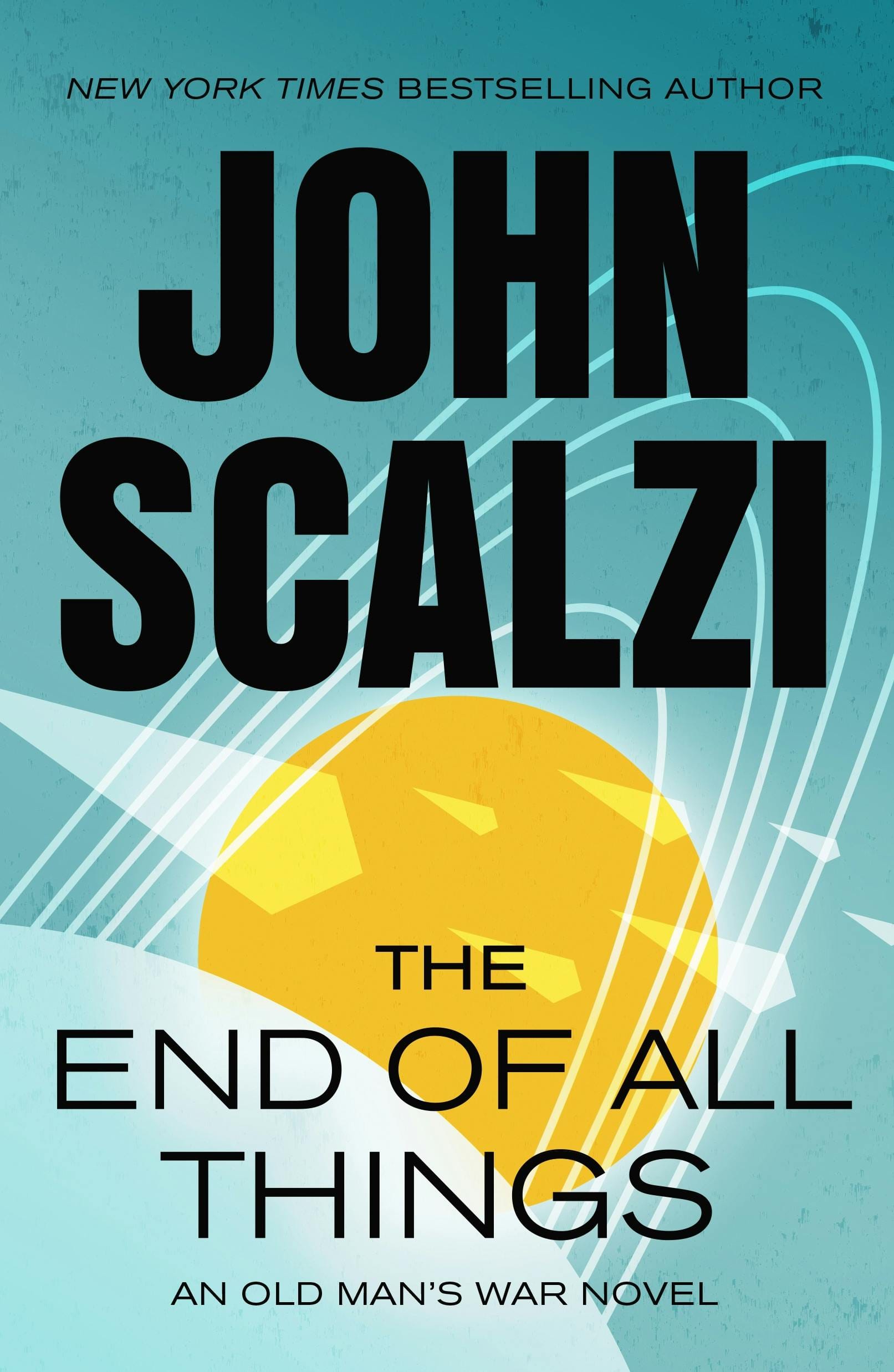
Five stars for the conclusion, and it turns out to be less final than expected: a new entry in the series just dropped after ten years. Exciting news for a book I thought had already closed the door on this universe.
Scalzi structures this as four connected novellas that still add up to one continuous plot, and that format works better than it has any right to. Each piece stands on its own while still pushing the larger story forward, which keeps the pacing tight in a series that could easily have sprawled by book six.
What makes it work, as always with Scalzi, is the banter. Interrogations, pre-combat small talk, tense political standoffs, all carried by dialogue that's sharp and funny even when the stakes are life or death. Rafe Daquin's snark plays off Harry Wilson's quiet, unshakeable confidence, and that pairing gives the book its emotional center even amid all the warfare and scheming. One alien character's paranoia gets summed up perfectly: "the problem is not that I'm paranoid. The problem is that the universe keeps justifying my paranoia." That's the tone of the whole book in one line.
There's a good running idea buried in here too, about how surviving hardship without full consciousness leaves behind something useful: restraint, mercy, empathy, the traces of struggle that keep a species from becoming something monstrous. Scalzi doesn't dwell on it, but it's doing quiet thematic work under all the plotting.
What's stuck with me most, though, is how prescient this book looks a decade later. Published in 2015, the Colonial Union reads uncomfortably like the US, the Conclave like a fragile coalition of the rest of the world, the Rraey like Russia, and the Equilibrium, the shadowy oligarchic faction pulling strings from behind the scenes, like something ripped straight out of the current moment. Scalzi even nails the mechanics of how thin the whole system really was: real threats to the Colonial Union, the Conclave, and Earth turned out to matter less than how determined those powers were to threaten themselves.
"If someone is telling you to live in interesting times, they are basically telling you they want you to die horribly." A very Scalzi way to put it. A satisfying close to the series, even if it's apparently not actually the close.
- Format: 368 pages, Kindle Edition
- Published: August 11, 2015 by Tor Books
- ISBN: 9781466849426 (ISBN10: 1466849428)
- ASIN: B00SEPVPAW
- Language: English
Humans expanded into space…only to find a universe populated with multiple alien species bent on their destruction. Thus was the Colonial Union formed to help protect us from a hostile universe. The Colonial Union used the Earth and its excess population for colonists and soldiers. It was a good arrangement...for the Colonial Union. Then the Earth said: no more.
Now the Colonial Union is living on borrowed time--a couple of decades at most, before the ranks of the Colonial Defense Forces are depleted and the struggling human colonies are vulnerable to the alien species who have been waiting for the first sign of weakness, to drive humanity to ruin. And there's another problem: A group, lurking in the darkness of space, playing human and alien against each other--and against their own kind --for their own unknown reasons.
In this collapsing universe, CDF Lieutenant Harry Wilson and the Colonial Union diplomats he works with race against the clock to discover who is behind attacks on the Union and on alien races, to seek peace with a suspicious, angry Earth, and keep humanity's union intact...or else risk oblivion, and extinction--and the end of all things.
Member discussion