
The Daughter of Time ★★★★★
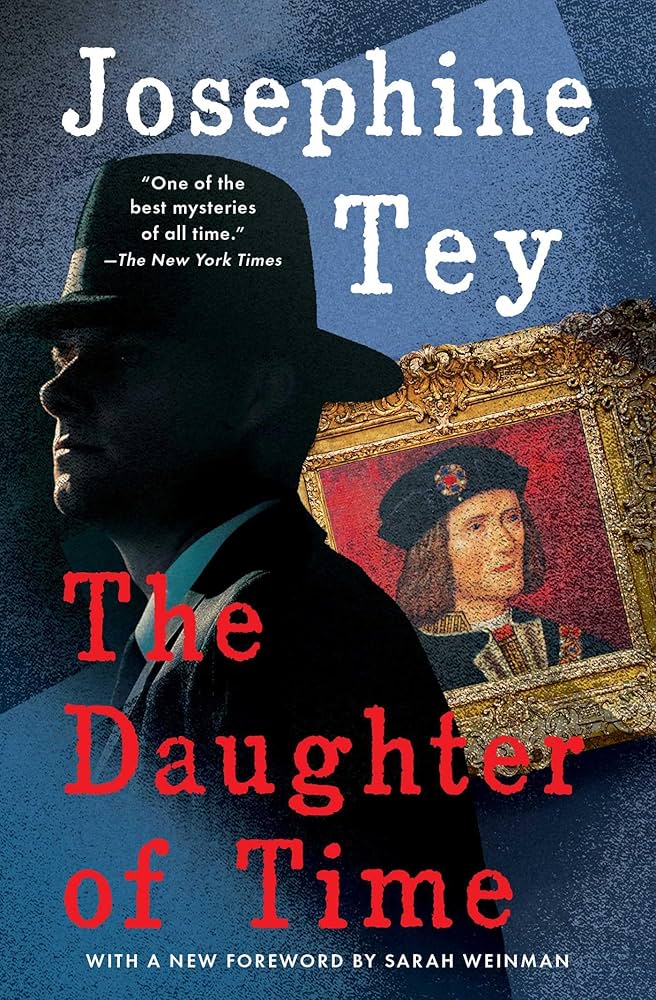
An excellent and logical solving of a historical mystery from a hospital bed helped by an enthusiastic research assistant. And he let him be first author!
- Format: 295 pages, Kindle Edition
- Published: January 8, 2013 by Touchstone
- ASIN: B00AB194RS
- Language: English
Josephine Tey is often referred to as the mystery writer for people who don't like mysteries. Her skills at character development and mood setting, and her tendency to focus on themes not usually touched upon by mystery writers, have earned her a vast and appreciative audience. In Daughter of Time, Tey focuses on the legend of Richard III, the evil hunchback of British history accused of murdering his young nephews. While at a London hospital recuperating from a fall, Inspector Alan Grant becomes fascinated by a portrait of King Richard. A student of human faces, Grant cannot believe that the man in the picture would kill his own nephews. With an American researcher's help, Grant delves into his country's history to discover just what kind of man Richard Plantagenet was and who really killed the little princes.
Notable Highlights
It was Grant’s belief that if you could not find out about a man, the next best way to arrive at an estimate of him was to find out about his mother.
For thirty years, over this green uncrowded land, the Wars of the Roses had been fought. But it had been more of a blood feud than a war. A Montague and Capulet affair; of no great concern to the average Englishman.
It was shocking how little history remained with one after a good education.
Grant had dealt too long with the human intelligence to accept as truth someone’s report of someone’s report of what that someone remembered to have seen or been told.
Historians say that the murder caused a great revulsion of feeling against Richard, that he was hated for the crime by the common people of England, and that was why they welcomed a stranger in his place. And yet when the tale of his wrongdoing is placed before Parliament there is no mention of the crime.
And it is on that account of Richard that all the later ones were built. It is on that story that Holinshed fashioned his history, and on that story that Shakespeare fashioned his character.”
He turned the pages and marvelled how dull information is deprived of personality. The sorrows of humanity are no one’s sorrows, as newspaper readers long ago found out. A frisson of horror may go down one’s spine at wholesale destruction but one’s heart stays unmoved. A thousand people drowned in floods in China are news: a solitary child drowned in a pond is tragedy.
This strong bond between novelist and reader is based on trust—trust in someone who is not only a first-rate storyteller but one who is not content with a formula. Tey, in her best books, seeks to tell different sorts of story, in different ways.
The stars merely reduce one to the status of an amoeba. The stars take the last vestige of human pride, the last spark of confidence, from one. But a snow mountain is a nice human-size yardstick.
Truth isn’t in accounts but in account books.” “A neat phrase,” Grant said, complimentary. “Does it mean anything?” “It means everything. The real history is written in forms not meant as history. In Wardrobe accounts, in Privy Purse expenses, in personal letters, in estate books.
Member discussion