
The Art of Spending Money: Simple Choices for a Richer Life ★★★☆☆
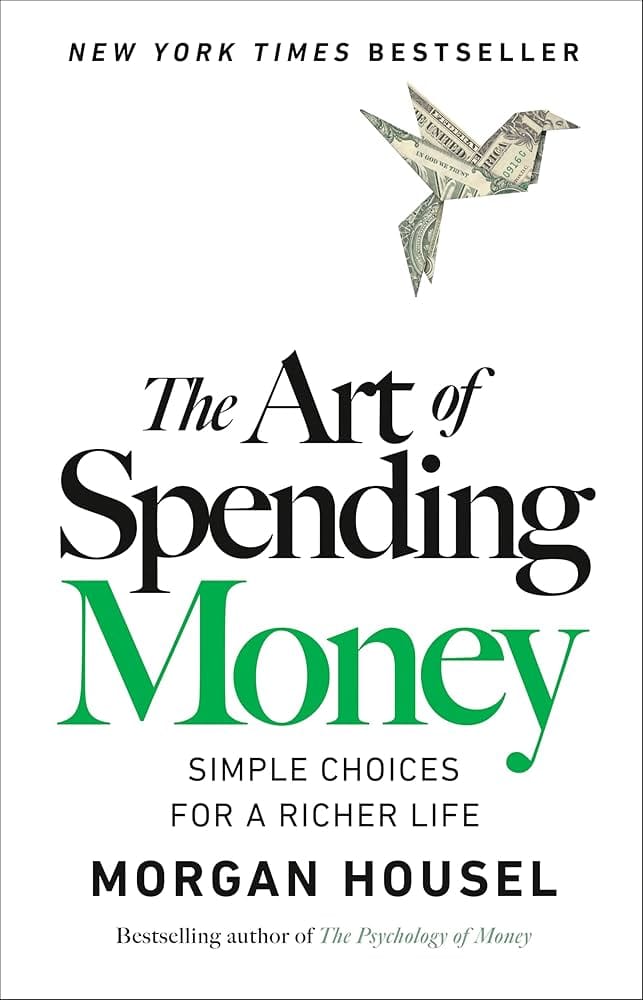
This was a disappointing read. I was a big fan of his "The Psychology of Money" which had some genuine insights on how you think about money. This book felt like an addendum to that book or rather a book that should've been a blog post. The advice is sound and sensible but there was much repitition with plenty of quotes by famous men sprinkled in.
Edition Read
- Author: Morgan Housel
- Date Published: 2025-01-01
- Pages: 257
Description
From the bestselling author of The Psychology of Money and Same as Ever, lessons on harnessing the power of money to live a happier life Most of us don’t know how to spend money. We chase things that impress others but leave us cold. Or we save endlessly, afraid to spend on what would actually make life better. We confuse admiration with envy, comfort with excess, and utility with status.
The Art of Spending Money doesn’t provide budgets, hacks, or one-size-fits-all solutions. It gives you understanding of how your relationship with money shapes your decisions—and how to reshape it so money works for you. Morgan Housel’s work has helped millions rethink how they earn, save, and invest. Now he turns his attention to the other side of the equation: how to spend.
With insight and warmth, he shows why the most valuable return on investment is peace of mind, why expectations matter more than income, and why doing well with money has less to do with spreadsheets and more to do with self-awareness. This book isn’t about getting rich. It’s about getting the most out of what you already have—and learning to want what’s worth wanting.
Source: Hardcover
Notable Highlights
There’s an old saying that nothing’s worse than getting what you want but not what you need. [loc. 92]
Carl Jung, one of the most influential psychologists to ever live, was once asked, “What do you consider to be more or less basic factors making for happiness in the human mind?” Jung listed them off: Good physical and mental health. Good personal and intimate relationships, such as those of marriage, the family, and friendships. The faculty for perceiving beauty in art and nature. Reasonable standards of living and satisfactory work. A philosophic or religious point of view capable of coping successfully with the vicissitudes of life. [loc. 144]
There are two ways to use money. One is as a tool to live a better life. The other is as a yardstick of status to measure yourself against others. Many people aspire for the former but spend their life chasing the latter. [loc. 158]
A big, nice house might make you happier, but mostly because it makes it easier to have friends and family over, and the friends and family are actually what are making you happy. Enduring happiness is found in contentment, so those happiest with money tend to be those who have found a way to stop thinking about it. You can value it, appreciate it, even marvel at it. But if money [loc. 165]
They wanted to have more money so they could become happier. But money could buy them everything except the ability to not be obsessed with money, which led to constant anxiety, which led to unhappiness. [loc. 183]
There’s a saying: Never make fun of someone for mispronouncing a word, because it means they learned it from reading. As a corollary: Never make fun of how someone spends their money, because they learned it from living. [loc. 203]
But there’s a saying inside the foster care system: All behavior makes sense with enough information. [loc. 212]
Related: I have noticed that those most capable of delayed gratification are often those who enjoy their work. The pay might be good, but the urge to compensate for your hard work with heavy spending isn’t there. [loc. 256]
“People are not rational. They are rationalizing. Once you understand this simple fact, all the oddest human behavior will suddenly make way more sense.” [loc. 264]
A healthy financial philosophy is having respect for others’ experiences, an appreciation of your own, and an understanding that all behavior makes sense with enough information. [loc. 340]
We value the attention money brings us more than we value the comfort and convenience of stuff that money can buy. [loc. 376]
So spending money is probably the fastest way to get attention, but it’s not durable attention, and it’s probably the least effective toward the people whose respect and admiration you actually desire. It’s like junk food: very tempting, immediately satisfying, but long-term damaging. [loc. 395]
psychologist Tim Kasser once pointed out that those who most value extrinsic pride have less bandwidth to pursue intrinsic pride. [loc. 419]
Ben Franklin used to say that one of the tricks in life is realizing that people will admire you more if they aren’t jealous of you. It can be hard to tell when the transition between admiration and jealousy takes place, and it’s common for a flashy person to think they are being admired when they are actually envied. [loc. 456]
Dutch political philosopher Jan-Willem van der Rijt has a good saying here: “The appetite for applause counts amongst the lowest of human character traits.” [loc. 462]
All happiness in life is just the gap between expectations and circumstances. The person who has everything but wants even more feels poorer than the person who has little but wants nothing else. How could it be any different? [loc. 516]
The best measure of wealth is what you have minus what you want. [loc. 587]
It’s hard to get really depressed until your dreams come true. Once your dreams come true and you realize you feel the same way you did before, then you get a feeling of hopelessness. [loc. 638]
Never focus on what money can do for you without a clear understanding of the cost of acquiring more of it. [loc. 701]
Jimmy Carr, says, “Everyone is jealous of what you’ve got, no one is jealous of how you got it.” So much of a good life is about what didn’t happen. It’s the fights you didn’t have, the illnesses you avoided, and the unhealthy desires you didn’t feed. It’s the unaffordable lifestyle you didn’t choose to live, the mistakes you didn’t make, and the regrets you don’t have. [loc. 707]
Not needing to impress other people, especially strangers, is an asset on your personal balance sheet that can be more valuable than anything else. [loc. 727]
The thing that is least perceived about wealth is that all pleasure in money ends at the point where economy becomes unnecessary. The man who can buy anything he covets, without any consultation with his banker, values nothing that he buys. [loc. 905]
One way to fight back is respecting the idea that occasional treats can generate more joy than perpetual luxury. [loc. 923]
Good advice is never as simple as saying “Live for today” or “Save for the future.” The only good advice is “Minimize future regret.” [loc. 1339]
Envy is inversely correlated with self-examination. The less you know yourself, the more you look to others to get an idea of your worth. But the more you delve into who you are, the less you seek from others, and the dissolution of envy begins. [loc. 1474]
There’s a line in the movie Boiler Room that goes, “People who say money can’t buy happiness don’t have any.” I would amend that to say: People who say money doesn’t buy happiness haven’t yet found their thing. They should keep trying. Wider funnel. [loc. 2020]
Anthony De Mello, always wise, says, “If you learn to enjoy the scent of a thousand flowers you will not cling to one or suffer when you cannot get it.” [loc. 2079]
“In families that I know have had a lot of problems—strained relationships—the child will often thank the parent for something that cost money,” he said. “Thank you for putting me through college. Thank you for putting food on the table. Thank you for buying me a car.” “In the best families, the ones I know have solid relationships,” he said, “the kids say the same thing every time.” “Thank you for believing in me.” [loc. 2090]
But everything I’ve seen tells me that when kids are young and living with their parents, the parents and the kids have to live the same material lifestyle. So you, the parent, need to pick that lifestyle carefully. “You haven’t earned what I have” can be a less effective message than “Let me teach you the value of hard work by doing it together.” Lead by example, not by humiliation. [loc. 2148]
I’ve come to believe that upward social mobility shouldn’t be our priority as a society. Rather, upward mobility should be the side effect of far more important things: family, stability, and emotional security for children. [loc. 2174]
The most important financial advice I can give to my kids is that money alone won’t provide the thing that they and almost everyone want most in life. No amount of money can compensate for a lack of character, honesty, and genuine empathy toward others. [loc. 2178]
Parkinson’s Law of Triviality. It states: “The amount of attention a problem gets is the inverse of its importance.” [loc. 2324]
All greed begins with the most innocent idea: that you deserve to be right. [loc. 2372]
Member discussion