
The Anarchy: The East India Company, Corporate Violence, and the Pillage of an Empire ★★★★☆
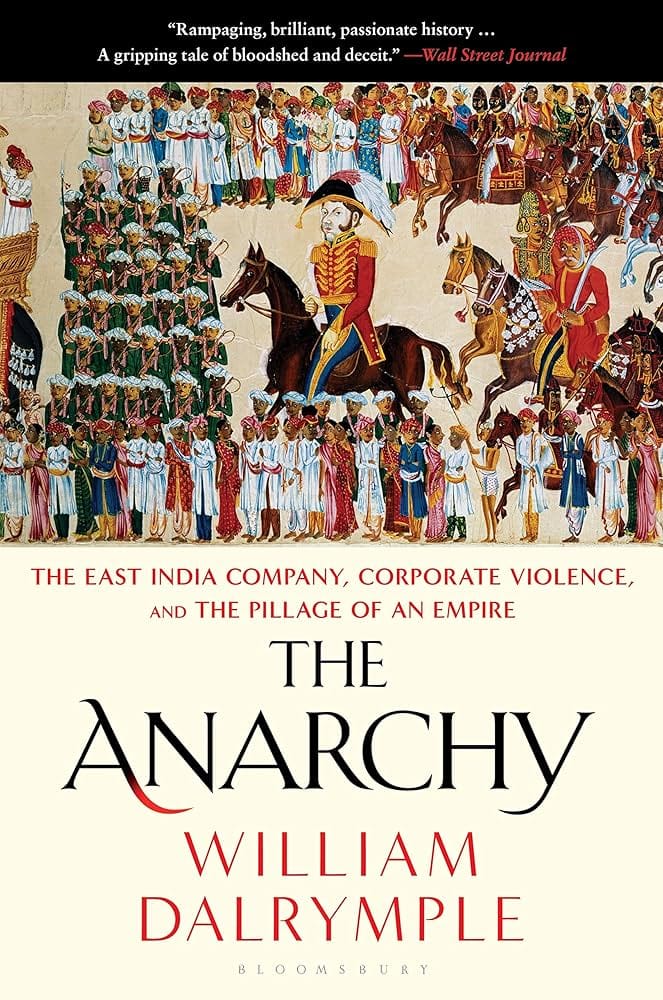
This book was a difficult read. Not in terms of the language or narration, which was in fact straightforward and evocative. But more as an Indian who had known, albeit more than the average Indian, but not fully realized how the East India Company subjugated and ruled India for nearly two centuries. It wasn't just one battle, although there were a few significant ones, even those not involving the English, that eventually led to the outcome we know. First, it wasn't India per se that they ruled.
Although the English called the subcontinent India, the people who lived there were citizens of several ever-changing empires and other smaller princely states. The notable among these were the Mughals, who ruled the northern parts and the eastern regions of Bengal (current Bangladesh), Orissa, and Bihar; the Marathas dominated the Western parts; and others, including the Nizam and Haider Ali/Tipu Sultan, held sway in the South. A little bit of luck, a little bit of treachery, a whole lot of in-fighting among and within these kingdoms, and the frequent invasions by the Afghans helped their cause. At times, they had to simply sit back and watch the "Indians" tear each other apart, often literally, and then saunter in to pick up the pieces as their reward.
The wealth that the current right-wing Hindu nationalist government claims India possessed was mostly accumulated and created by the Mughals. Ironically, the current-day Hindus label the Mughals as outsiders responsible for looting India, whereas in fact, they came to India in the 12th century and came to be natives over the next six hundred years. Except for a stray fanatic Emperor, most were secular and, in fact, governed with great respect, although the English exploited their increasing naivety. All the "loot" that the Indians, even to this day, demand back from the English, like the Kohinoor diamond, was in fact the property of the Mughals.
But as with all history that you read in hindsight, the English rule almost never happened and could've been easily avoided if certain factions (Marathas and Tipu Sultan) or even the Holkars & Scindias within the Marathas had banded together. In fact, this happened contemporaneously with the American War of Independence and involved the same General (Charles Cornwallis) who surrendered to Washington in 1781 and later, within the decade, defeated the Mysorean ruler Tipu Sultan in 1791. [^Followed up by Arthur Wellesley's (Duke of Wellington) ending the Anglo-Mysore wars by defeating Tipu Sultan in 1799, and then defeating Napoleon at the Battle of Waterloo in 1815. A little tidbit: Tipu Sultan was counting on Napoleon's help in defeating the British, but Napoleon got waylaid in Egypt; small world, eh?] At that point, just before Tipu's defeat, the East Indian Company was almost bankrupt and would've ceased to exist if only the Marathas had come to Tipu's aid and helped defeat the British. Who knows if the trajectories of India and the U.S. would've looked similar if the British had lost at both ends of the world at the same time? But America's gain became India's loss, as the East India Company soon after became one of the world's foremost corporations not only in wealth but also militarily and politically.
What we call the British, the English referred to as the East India Company and feared it just as much before finally nationalizing it in 1758, a year after the barbaric suppression of the Mutiny (or India's First War of Independence), and then completely dissolved it in 1874.
More than history, this book is a good example of the excesses of a corporation and how powerful it can get if left unchecked. At heart, the goal wasn't to subjugate the people or conquer foreign lands but mostly to amass wealth and maximize shareholder value. The atrocious things that we now remember them for were mostly just a means to an end or even a by-product of the outcome. The two Bengal famines were just as severe as the famines in Ukraine and China in the mid-20th century and were also a result of human malice toward their own kind. If you think Google, Meta, Apple, or Amazon are bad now, you've no idea how bad the East Indian Company was. At least Google doesn't have its own infantry, and Apple doesn't have its own Navy. Imagine if they did.
Also, the underlying element in these wars and subsequent plunder was the unimaginable barbarity. Even in words, it sounds so horrible that it makes you want to turn your eyes (or ears if it's an audiobook) away. This wasn't just on the part of the British but also among the natives themselves. The world, as much as it seems on fire recently, was a much more horrible place as recently as a couple of centuries ago.
- Format: 544 pages, Audiobook.
- Published: September 10, 2019 by Bloomsbury Publishing
- ISBN: 9781635573954 (ISBN10: 1635573955)
- ASIN: 1635573955
- Language: English
The story of how the East India Company took over large swaths of Asia, and the devastating results of the corporation running a country.
In August 1765, the East India Company defeated the young Mughal emperor and set up, in his place, a government run by English traders who collected taxes through means of a private army.
The creation of this new government marked the moment that the East India Company ceased to be a conventional company and became something much more unusual: an international corporation transformed into an aggressive colonial power. Over the course of the next 47 years, the company's reach grew until almost all of India south of Delhi was effectively ruled from a boardroom in the city of London.
Member discussion