
SPQR: A History of Ancient Rome
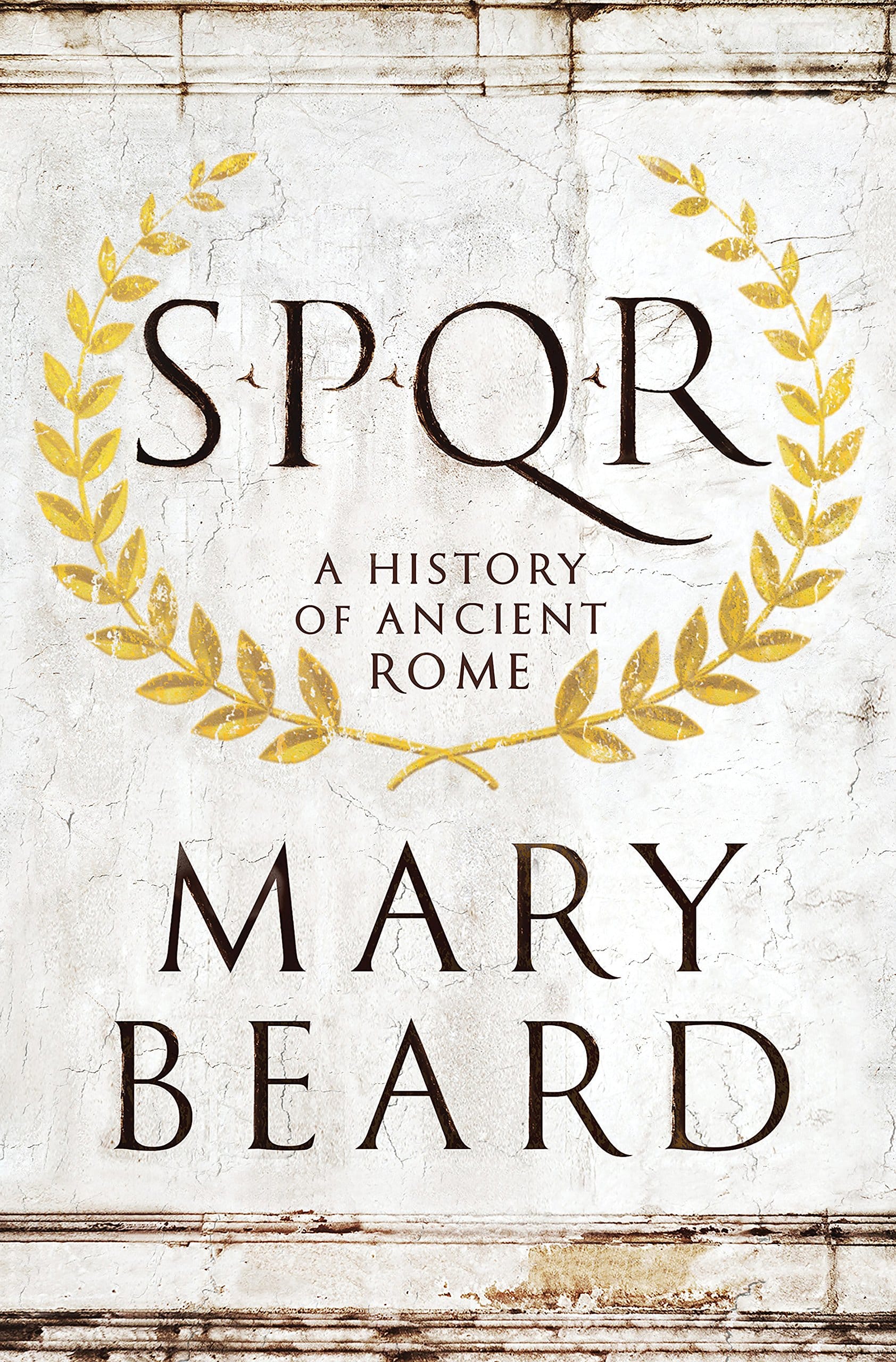
I came to this sideways, after reading about ancient Egypt and learning that its empire, which lasted three millennia, was eventually swallowed by Rome's. That got me curious about how Rome actually built what we were taught as kids to think of as the ultimate empire. Beard's answer is partly mundane and partly profound: Rome left behind an enormous, detailed record of itself. As she puts it, there's no earlier period in Western history we can know as intimately, and we don't get anything comparable again until Renaissance Florence. That volume of documentation is why Rome dominates the story, not necessarily because it was uniquely greater than everything around it.
The title itself is a small lesson in Roman self-conception. SPQR stands for Senatus Populusque Romanus, "The Senate and People of Rome," and the Republic it names was built to prevent any one man from becoming a king, through what Beard calls a careful balance of consuls, senate, and people, so that no single form of government ever fully won out. It didn't work, obviously. But the failure produced extraordinary material, all the way to Caesar's assassination in the Senate in 44 BCE.
What struck me most is how condensed the famous part of the story actually is. Compared to Egypt's three thousand years, the Rome we learn about in school, the Republic, the civil wars, the rise of the empire, unfolds across roughly three or four centuries. And like the Marathas in Indian history, Rome hit its real peak not under its most famous figure but under the ones who came after him.
Beard is also clear-eyed about how unreliable all of this is. Even Roman historians couldn't be trusted at face value, let alone the ones writing about Rome today. She's blunt that we're not smarter than our predecessors, just working from different priorities that make old evidence speak to us differently.
That epistemic humility is rare in popular history, and it's part of what makes this book worth the length. Beard spent fifty years on roughly the first half of Rome's history and still says she hasn't read everything there is to read about it.
PS: The detail that Rome's founding myth includes welcoming in criminals, runaways, and foreigners as citizens says a lot about why it grew as fast and as far as it did.
Edition Read
- Edition Type: Hardcover
- Number of Pages: 696 pages
- Date First Published: October 19, 2015
- Publisher: Liveright
- ISBN10: 5916716397
- ASIN: 5916716397
- Language: English
Description
In SPQR, an instant classic, Mary Beard narrates the history of Rome "with passion and without technical jargon" and demonstrates how "a slightly shabby Iron Age village" rose to become the "undisputed hegemon of the Mediterranean" (Wall Street Journal).
Hailed by critics as animating "the grand sweep and the intimate details that bring the distant past vividly to life" (Economist) in a way that makes "your hair stand on end" (Christian Science Monitor) and spanning nearly a thousand years of history, this "highly informative, highly readable" (Dallas Morning News) work examines not just how we think of ancient Rome but challenges the comfortable historical perspectives that have existed for centuries.
With its nuanced attention to class, democratic struggles, and the lives of entire groups of people omitted from the historical narrative for centuries, SPQR will to shape our view of Roman history for decades to come.
Source: GoodReads
Notable Highlights
At this period, they alone could elect the political officials of the Roman state; no matter how blue-blooded you were, you could only hold office as, say, consul if the Roman people elected you. And they alone, unlike the senate, could make law.
The main reason that London is the capital of the United Kingdom is that the Romans made it the capital of their province Britannia – a dangerous place lying, as they saw it, beyond the great Ocean that encircled the civilised world.
The secret, Polybius suggested, lay in a delicate relationship of checks and balances between consuls, the senate and the people, so that neither monarchy nor aristocracy nor democracy ever entirely prevailed.
Custodial sentences were not the penalties of choice in the ancient world, prisons being little more than places where criminals were held before execution. Fines, exile and death made up the usual repertoire of Roman punishment.
There is no earlier period in the history of the West that it is possible to get to know quite so well or so intimately (we have nothing like such rich and varied evidence from classical Athens). It is not for more than a millennium, in the world of Renaissance Florence, that we find any other place that we can know in such detail again.
Rome was not simply the thuggish younger sibling of classical Greece, committed to engineering, military efficiency and absolutism, whereas the Greeks preferred intellectual inquiry, theatre and democracy.
SPQR takes its title from another famous Roman catchphrase, Senatus PopulusQue Romanus, ‘The Senate and People of Rome’.
Rome was the only place in the ancient Mediterranean where the state took responsibility for the regular basic food supplies of its citizens.
The message is clear: however far back you go, the inhabitants of Rome were always already from somewhere else.
In general, it was a religion of doing, not believing.
It is a dangerous myth that we are better historians than our predecessors. We are not. But we come to Roman history with different priorities – from gender identity to food supply – that make the ancient past speak to us in a new idiom.
When we are discussing the realities, rather than the myths, of this early period of Rome’s history, it might be better to think in terms of chiefs or big men instead of kings, and to think of the ‘chiefly’ rather than the ‘regal’ period.
There was one obligation that the Romans imposed on all those who came under their control: namely, to provide troops for the Roman armies.
The senators had already, in October, issued a decree urging (or allowing) Cicero as consul ‘to make sure that the state should come to no harm’, roughly the ancient equivalent of a modern ‘emergency powers’ or ‘prevention of terrorism’ act, and no less controversial.
Two central tenets of Republican government were that office holding should always be temporary and that, except in emergencies when one man might need to take control for a short while, power should always be shared.
Even today, in mechanically printed editions, they keep their place in the syllabus for those who learn Latin, and they remain models of persuasive oratory, whose techniques underlie some of the most famous modern speeches, including those of Tony Blair and Barack Obama.
In fact, the modern word ‘candidate’ derives from the Latin candidatus, which means ‘whitened’ and refers to the specially whitened togas that Romans wore during election campaigns, to impress the voters.
‘Bitter fate pursues the Romans, and the crime of a brother’s murder, ever since the blood of blameless Remus was spilt onto the ground to be a curse on his descendants.’ Civil war, we might say, was in the Roman genes.
Edgy in a different way was the idea of the asylum, and the welcome, that Romulus gave to all comers – foreigners, criminals and runaways – in finding citizens for his new town. There were positive aspects to this. In particular, it reflected Roman political culture’s extraordinary openness and willingness to incorporate outsiders, which set it apart from every other ancient Western society that we know.
In Sallust’s view, the moral fibre of Roman culture had been destroyed by the city’s success and by the wealth, greed and lust for power that had followed its conquest of the Mediterranean and the crushing of all its serious rivals.
These are supplemental highlights made by other readers.
Member discussion