
Martyr ★★★★★
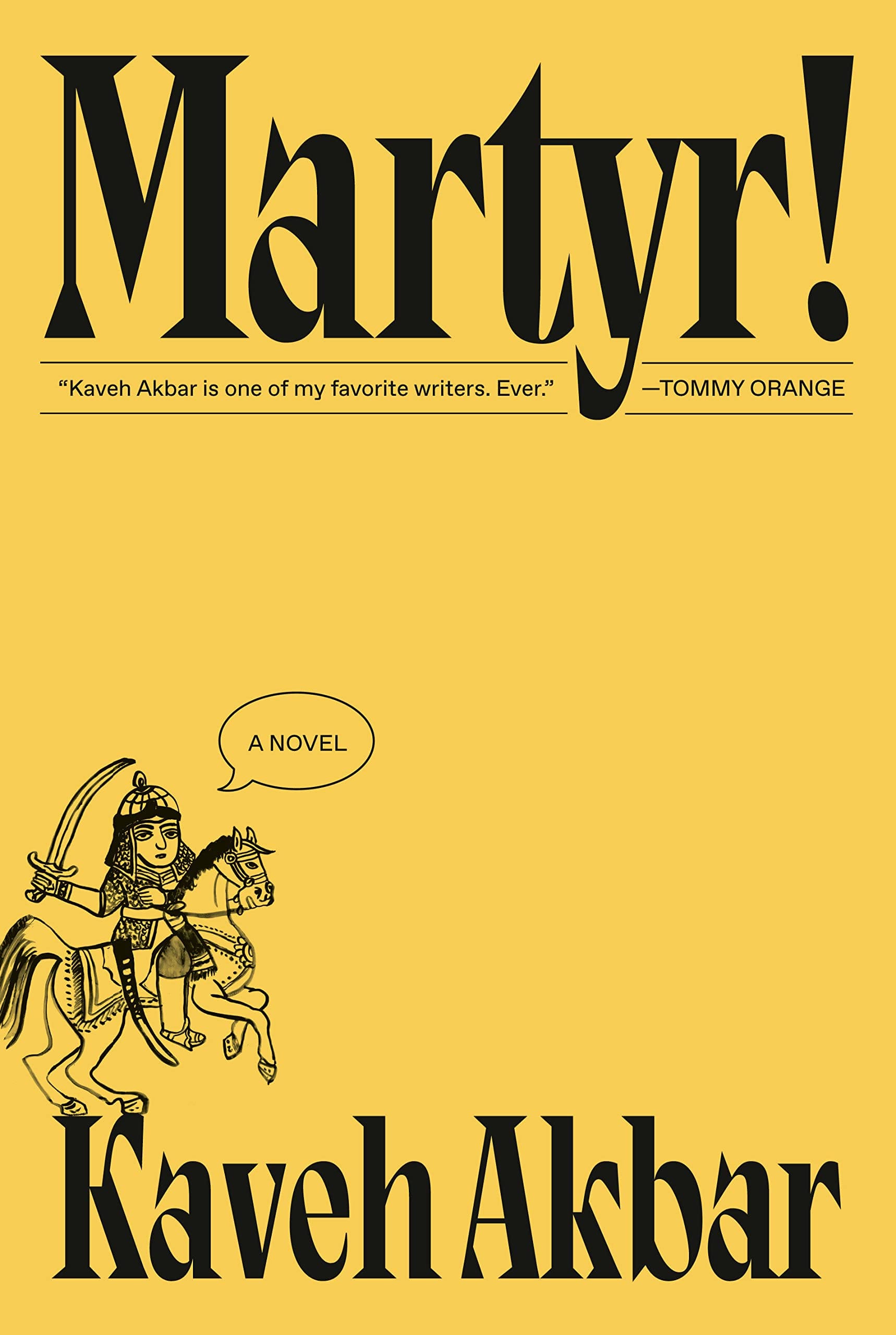
Written by a poet, it has exquisite prose. It explores fundamental questions of one's existence when surrounded by death and sorrow, and the quest to find meaning in one's life by wishing for death.
- Published: January 22, 2024, by Knopf Doubleday Publishing Group
- ISBN9780593537626 (ISBN10: 0593537629)
- ASIN B0C3C886FY
- LanguageEnglish
Notable Highlights
How was it fair to celebrate those guys for faith that wasn’t faith at all, that was just obedience to what they plainly observed to be true? And what sense did it make to punish the rest of humanity who had never been privy to such explicit revelation? To make everyone else lurch from crisis to crisis, desperately alone? [loc. 167]
“There’s no difference to the outside world between a good guy and a bad guy behaving like a good guy. In fact, I think God loves that second guy a little more.” “Good-person drag,” Cyrus thought out loud. That’s what they called it after that. [loc. 287]
Booze worked that way sometimes, clarifying—briefly—what his mind couldn’t. It was like sitting in the optometrist’s office, booze flashing its different lenses in front of your face and sometimes, for a second, it’d be the right prescription, the one that allowed you to catch a glimpse of the world as it was, beyond your grief, beyond your doom. That was the clarity alcohol, and nothing else, gave. [loc. 306]
“Can you imagine having that kind of faith?” Cyrus asked. “To be that certain of something you’ve never seen? I’m not that certain of anything. I’m not that certain of gravity.” “That certainty is what put worms in their brains, Cyrus. The only people who speak in certainties are zealots and tyrants.” [loc. 470]
What was left of his life had no intrinsic meaning, he knew, since such meaning could only be shaped in relation to other people. [loc. 782]
Like boiling water poured into a cup then poured over his head. He felt scorched, confused, suddenly alive. [loc. 1461]
Living happened till it didn’t. There was no choice in it. To say no to a new day would be unthinkable. So each morning you said yes, then stepped into the consequence. [loc. 1543]
It’s possible, he thought, that the experience of gratitude was itself a luxury, a topless convertible driven through a rainless life. [loc. 1577]
She was Christian but American Christian, the kind that believed Jesus had just needed a bigger gun. [loc. 1834]
The iron law of sobriety, with apologies to Leo Tolstoy: the stories of addicts are all alike; but each person gets sober their own way. Addiction is an old country song: you lose the dog, lose the truck, lose the high school sweetheart. In recovery you play the song backward, and that’s where things get interesting. Where’d you find the truck? Did the dog remember you? What’d your sweetheart say when they saw you again? [loc. 1967]
Two yellow birds, goldfinches, flew in from opposite sides of the lot and crashed violently into each other mid-air. A tantrum of feathers fell to the parking lot asphalt. There, they kicked up the sort of angry dust bubble you see in cartoon fights. Claws, beaks, exclamation points. [loc. 2250]
“It seems very American to expect grief to change something. Like a token you cash in. A formula. Grieve x amount, receive y amount of comfort. Work a day in the grief mines and get paid in tickets to the company store.” [loc. 2515]
He remembered reading about how children who had lost a parent would often act out against the one left, an unconscious way of testing whether that parent could be trusted to remain, unconditionally. [loc. 2791]
He read once about a Sufi prayer that went “Lord, increase my bewilderment.” That was the prayer in its entirety. [loc. 2828]
If the mortal sin of the suicide is greed, to hoard stillness and calm for yourself while dispersing your riotous internal pain among all those who survive you, then the mortal sin of the martyr must be pride, the vanity, the hubris to believe not only that your death could mean more than your living, but that your death could mean more than death itself—which, because it is inevitable, means nothing. [loc. 3395]
Seneca said grief should last no longer than seven years. Anything more was indulgent. Nazim Hikmet said twentieth-century grief lasted at most a year. It dwindled like that. Maybe twenty-first-century grief had gotten down to a fraction of that fraction, just a few hours before it was supplanted by necessity. [loc. 3635]
It’s easy for people who have sacrificed nothing to rationalize their own ordinariness by calling me lucky. But I sacrificed my entire life; I sold it to the abyss. And the abyss gave me art. [loc. 3902]
“You think there’s some nobility in being above anger?” Sang asked. “Anger is a kind of fear. And fear saved you. When the world was all kneecaps and corners of coffee tables, fear kept you safe.” [loc. 4028]
It’s a dirty fuel, but it works. And anger? Anger helped me to leave him. To get my boys away from him as soon as I could. To come thrive in this country that didn’t even believe we were people. To prove it wrong. You can put a saddle on anger, Cyrus.” [loc. 4035]
Cyrus once read an anthropologist who wrote about how the first artifact of civilization wasn’t a hammer or arrowhead, but a human femur—discovered in Madagascar—that showed signs of having healed from a bad fracture. In the animal world, a broken leg meant you starved, so a healed femur meant that some human had supported another’s long recovery, fed them, cleaned the wound. And thus, the author argued, began civilization. Augured not by an instrument of murder, but by a fracture bound, a bit of food brought back for another. [loc. 4081]
Member discussion