
India After Gandhi: The History of the World's Largest Democracy ★★★★★
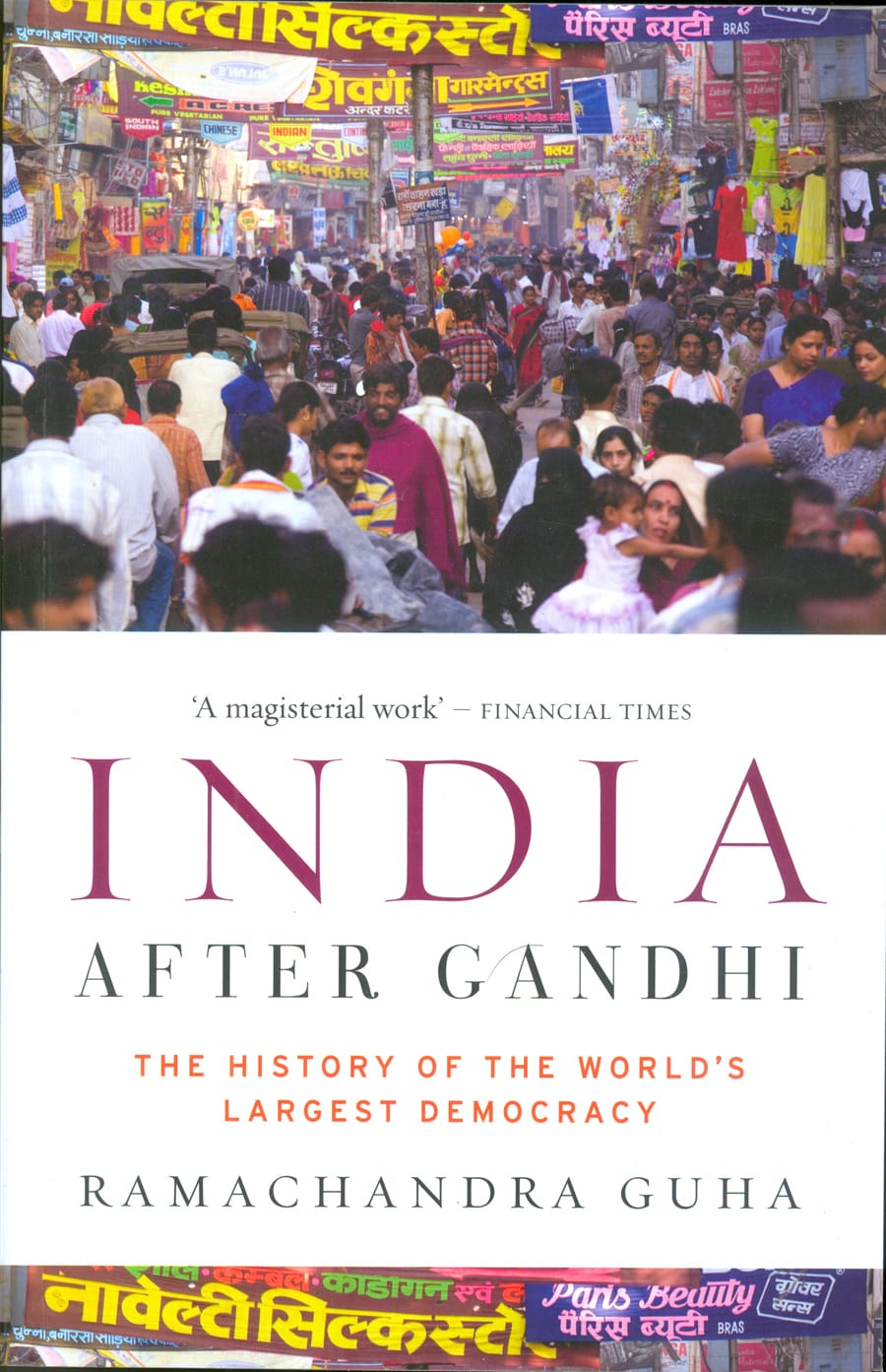
Given the number of blog posts, magazine (and journal) articles, and news reports I read these days, I had almost given up on books with more than 300 pages often citing attention deficit as a lame excuse, as compared to other people who seem to chew on books like a raging bull. But when I finally found Ramchandra Guha's India after Gandhi in the local public library, I picked it up instantly with little regard to its 900-odd pages.
Considering that the only time I get to read books is just before bed, I was wondering if I could even get through it but I'm proud to say I managed to finish it yesterday. I had keenly followed Amardeep's discussions on Sepia Mutiny on the book and also enjoyed Chandrahas's interview with the author (before linking it recently on DesiPundit). This post is less a review than a reflection of my thoughts upon reading the book.
As Guha himself admits that his life so far has been as if in preparation for writing this book and the endeavor of documenting India's hitherto untold history has been painstakingly researched if not comprehensively described. As the author notes early in the book, Indian history as we have learnt in our school books or even popular history often stops abruptly on the day of India's independence and is liberally laced with stories of our non-violent (and revolutionary) freedom struggle and heroic tales of kings, warriors, and philosophers before that. The period post-Independence is often muddled with a broad brush of civics lessons where we learn by rote the qualifications needed to contest an election in a democratic India. For that matter, Civics isn't even an independent stand-alone subject in schools and is often added on as an unnecessary appendage in the social studies bundle.
As you go through Guha's book starting from the days just before Independence, you are revealed the political mechanisms of that era and the intense struggle of power transfer from the British to the natives. India never had a large scale revolutionary war where we drove out the British and captured Delhi. In fact, the British ruled on less than one-third of India as we know today with the rest being ruled independently by princely states.
We have vague notions of Vallabhbhai Patel, the 'iron man' of India muscling his way to create a united India but we were never told about the backdoor politics that went into bringing India together. It was literally like a haphazard jigsaw puzzle that took years to assemble with some parts in the North and Northeast still refusing to assimilate completely. Sadly apart from the notoriously violent regions of first Punjab and now Kashmir, we as students somehow never realize that the period after Independence wasn't a joyous time spent in celebrating our new-found freedom and building the nation while singing Mere Desh Ki Dharti.
Although Guha unabashedly holds Nehru in high esteem and focuses on his role as a statesman with noble intentions only to be disappointed by people he chose to trust, he also highlights his failings and its consequences on our state of affairs. By hindsight, we have learned that Nehru's socialist policies held us back for far too long even as erstwhile communist and imperialist countries like China and Japan leaped forward. We often have read of Congress's stranglehold on the political scene for the first three decades of Independent India but somehow we missed the memo on the role of the opposition parties like Jana Sangh and the Communists during that time. We wonder now why some states continue to vote for the Communists and other regional parties creating a fragile coalition government in the center but we haven't been exposed to the rich and tumultuous history of states formation and regional struggles that may have created those power imbalances.
Each new government tries to rewrite history with Murli Manohar Joshi trying to saffronize it while Arjun Singh trying to please his high command but sadly no one tries to find the middle ground by striving for the truth. If truth is disputed then we are scarcely offered the arguments of the other side. Guha's work thus fills a void in our understanding of our modern history by narrating the happenings of that era. We may approach his book with our own personal biases and prejudices that have been tainted with misinformed knowledge but for the open-minded, it is an excellent account of Indian politics.
As Guha notes in his interview with Chandrahas, this book could easily have been longer and certain personalities like Sheikh Abdullah, AZ Phizo, JB Kripalani, JP Narayan, and NT Rama Rao who merit frequent mention in the book and are hardly mentioned in our popular political conversations deserve their own dedicated full-length biographies. The role of these personalities have been just as important to the fabric of our country as the Nehru-Gandhi family who often hog the limelight. The movement from cadre-based system in our political system to dynastic rule, regardless of party, indicates the morass our democratic process finds itself in.
Nehru is often vilified for his role in the failed non-aligned movement and central planning policies but in fact, his daughter Indira who is often seen as India's shining light was the greater villain in terms of India's progress. Guha doesn't shy away from exposing Rajiv Gandhi's political maneuvering in the Shah Bano case and subsequent opening of the locks at Ayodhya to correct the balance between two warring religions; the effects of which we continue to feel even today. Guha stays on the ball by not talking about Pakistan's internal struggles and emphasizes that India as a nation had many problems apart from the oft-talked about Kashmir issue. It is a myth that India would have been much peaceful if the Kashmir issue had been resolved.
As I mentioned at the outset, I will not be doing justice to the book by even trying to review it but I must highly recommend it as a must-read to anyone who is remotely interested in Indian history. Although I would have wished for more information on India's economic history, Guha successfully packs much information on politics and social movements in these 750+ pages (plus acknowledgments and notes) than you would have to find in countless other disparate sources. By the time you finish reading the book, you will realize that India has succeeded as a nation beyond anyone's wildest imaginations and snarky comments on its disintegration has always been proven wrong. The elephant continue to trudge along slowly yet surely.
To conclude, I think Helloji's last word on his post on Inscrutable India best describes Guha's book - India is confusing as a nation. India is comforting as a notion.
Member discussion