
How To Be Idle ★★★★★
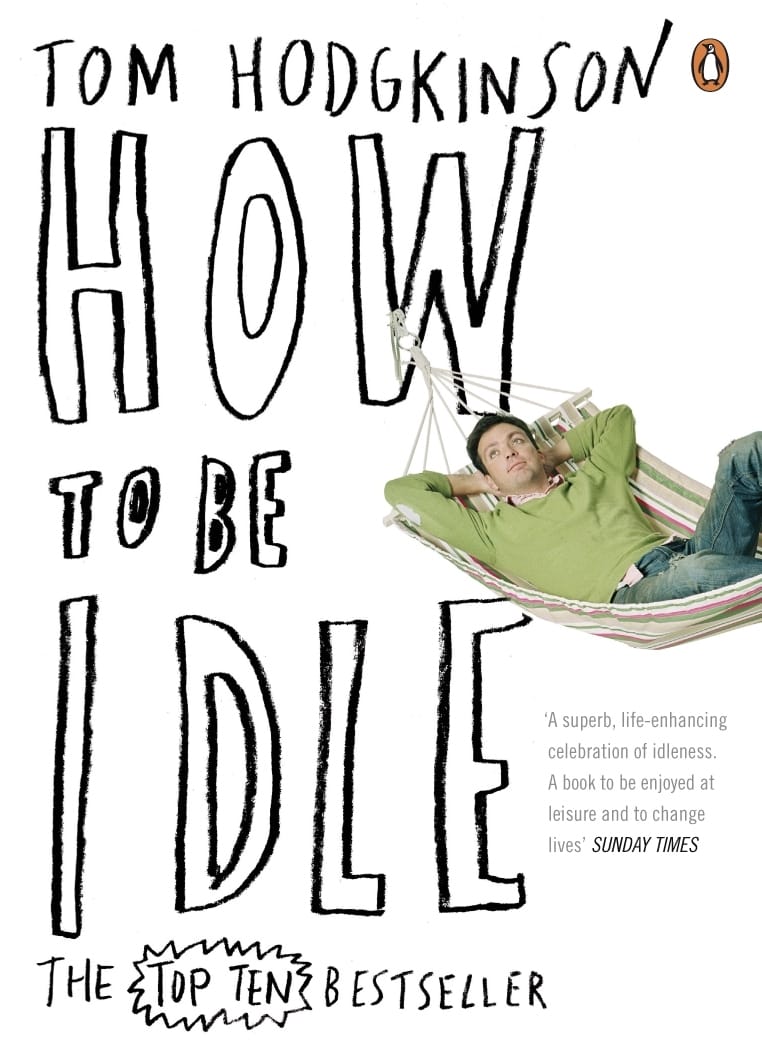
This book found me at the right age to actually appreciate it.
If I'd read this in my twenties, I would have dismissed it as an argument for laziness and moved on. Pushing fifty, I read it differently. Hodgkinson isn't arguing against effort. He's arguing against the idea that constant busyness is a virtue, and that argument lands a lot harder once you've lived enough of your life inside that busyness to feel its cost.
Yes, some of this is a privileged position to argue from. Hodgkinson can afford to romanticize afternoon naps and long pub conversations because his circumstances allow it. But he's right that most people reading a book like this or even this blog post aren't working three jobs to survive. Most of us have more room to slow down than we admit, and the guilt that keeps us busy often does more work than is necessary.
The book works because of its format. Hodgkinson takes the reader hour by hour through a single day, and at each hour, unpacks a specific flavor of idleness we all crave and feel ashamed of wanting: the doze that isn't quite sleep, the walk with no destination, the drink that marks the end of obligation. He's sharp on how modern life has hollowed out spaces that used to exist for exactly this. The old coffeehouse, he points out, was a "loafing center par excellence," nothing like the efficient sandwich counter it's become.
He's also good on how idleness gets policed. A person standing still with no purpose becomes suspicious in a way that a person rushing somewhere never does, which says more about our relationship to time than it does about the person standing still.
If you're anywhere near burnout, this is worth reading, not for permission to quit everything, but as proof that the exhaustion isn't mandatory.
PS: I read this one in paperback at the breakfast table during the day, which felt like the correct way to read it. Most books get the bed and the dark. This one earned the daylight.
Edition Read
- Edition Type: Paperback
- Number of Pages: 352 pages
- Date First Published: January 1, 2004
- Publisher: Penguin UK
- ISBN10: 0141015063
- ASIN: 0141015063
- Language: English
Description
How to be Idle is Tom Hodgkinson's entertaining guide to reclaiming your right to be idle. As Oscar Wilde said, doing nothing is hard work. The Protestant work ethic has most of us in its thrall, and the idlers of this world have the odds stacked against them. But here, at last, is a book that can help. From Tom Hodgkinson, editor of the Idler, comes How to be Idle, an antidote to the work-obsessed culture which puts so many obstacles between ourselves and our dreams.
Hodgkinson presents us with a laid-back argument for a new contract between routine and chaos, an argument for experiencing life to the full and living in the moment. Ranging across a host of issues that may affect the modern idler - sleep, the world of work, pleasure and hedonism, relationships, bohemian living, revolution - he draws on the writings of such well-known apologists for idleness as Dr Johnson, Oscar Wilde, Robert Louis Stevenson and Nietzsche. His message is take control of your life and reclaim your right to be idle. '
Well written, funny and with a scholarly knowledge of the literature of laziness, it is both a book to be enjoyed at leisure and to change lives' Sunday Times 'In his life and in this book the author is 100 per cent on the side of the angels' Literary Review 'The book is so stuffed with wisdom and so stuffed with good jokes that I raced through it like a speed freak' Independent on Sunday Tom Hodgkinson is the founder and editor of The Idler and the author of How to be Idle, How to be Free, The Idle Parent and Brave Old World. In spring 2011 he founded The Idler Academy in London, a bookshop, coffeehouse and cultural centre which hosts literary events and offers courses in academic and practical subjects - from Latin to embroidery. Its motto is 'Liberty through Education'. Find out more at www.idler.co.uk.
Source: GoodReads
Notable Highlights
The idea of the "job" as the answer to all woes, individual and social, is one of the most pernicious myths of modern society. It is promoted by politicians, parents, newspaper moralists and leaders of industry, on the left and on the right: paradise, they say, is "full employment." One key index to the success of a country is the size of its unemployed population. The more people have jobs, the better, we are told [p. 15]
For what is Progress? Clint Eastwood's preacher in Pale Rider puts the matter elegantly. When told by a local town fat cat that a group of independent gold miners who refuse to move off their land to make way for his company are "standing in the way of Progress," Clint simply asks: "Yours or theirs?" [p. 20]
The thundering polemicist Thomas Carlyle did much damage in the nineteenth century by promoting the notion of the dignity or even the romance of hard graft. "Man was created to work, not to speculate, or feel, or dream," he wrote, adding: "Every idle moment is treason." It is your patriotic duty to work hard-another myth, particularly convenient to the rich, who, as Bertrand Russell said, "preach the dignity of labour, while taking care themselves to remain undignified in this respect." [p. 23]
The great pleasure of skiving is that you are not working while you are meant to be working. In my own case, this might include pacing around the room, frittering time away on emailing and word counts while I am supposed to be writing. This pleasure was observed and beautifully defined by Jerome K. Jerome in the phrase: "There is no fun in doing nothing when you have nothing to do." Jerome, whose own version of idling consisted of spending inordinate amounts of time over small amounts of work, continued: "Idleness, like kisses, to be sweet must be stolen." [p. 40]
The hungover person is abnormally aware of sights, sounds (everything seems TOO LOUD!), tastes, odours, and textures which normally would go unremarked. That's a good thing, not a bad thing. The hungover eye, for instance, because it is neither obstructed by the blinkers of our everyday biases, nor deceived by intoxicated hallucinations, is magnetically attracted to seemingly ordinary objects which take on an incredible, luminous significance: Anyone who has ever experienced the "stares" when hungover knows exactly what I mean. [p. 55]
Observing 1930s New York, Lin Yutang also complained that the speed of life was destroying the pleasure of eating. "The tempo of modern life is such that we are giving less and less time and thought to the matter of cooking and feeding... it is a pretty crazy life when one eats to work and does not work in order to eat." [p. 59]
In the UK and in the United States, idlers have witnessed with horror the rise of the Starbucks-style coffee shop, which is where many of us grab a lunchtime sandwich these days. The coffee shops of the twenty-first century have little or nothing in common with the coffee shops of the eighteenth century, which were loafing centres par excellence, serving vast bowls of alcoholic punch and existing to facilitate convivial exchanges [p. 61]
That being ill can be a delightful way to recapture lost idling time is a fact well known to all young children. In schooldays, the independent child soon learns that if he is ill, then he can lie in bed all day, avoid work and be looked after. What a different world from the everyday one of punishments, recriminations and duties. Suddenly everyone is very nice to you. You can read comics and watch TV. You can very decisively NOT be at school. It is a time to embrace the "exquisite languor of surren der," as the writer Peter Bradshaw put it in his 1994 Idler article "The Joy of Sicks." [p. 68]
Suffering is part of life; it is how one deals with suffering that counts. Then the illness can become a pleasure as much as a trial. First we need to overcome our guilt at being ill, then we need to take time off work as necessary. We need to welcome the illness in, cosset it, make friends with it, ask it to stay, be sad to see it leave. [p. 77]
Buddhism certainly seems to me the most human of all religions, the most life-giving and fun, for the paradoxical reason that it embraces suffering. There seems to be none of the guilt or sense of indebtedness that ruins Christianity for most of us [p. 90]
And by conspicuously wandering in this way, for its own sake, without purpose, you become a figure of suspicion in fastmoving cities like London. "Move on, move on," policemen will say to loiterers. In the accusation "loitering with intent" is captured the authorities' inherent distrust of a loafer; I mean how could they possibly know that the loiterer has some evil intent in mind? Are they mind-readers? It is assumed that someone who is doing nothing is necessarily planning mischief when in fact what could be more harmless than going for a walk? [p. 104]
You can see it in our faces: just walk round a city at 6 p.m. and look in through the windows of the pubs and bars-you will see smiling people, full of animated chatter. They may be complaining about the boss or their lot in general, but for a little while, and before they return to the realities of home, they are in a delightful suspended reality, where everyone is a little king or queen. [p. 113]
Sensible people advise against drinking on an empty stomach, out to my mind it is the best sort of drinking. There is a sublime magic to that first drink of the evening. The cocktail, beer or wine goes straight to the nervous system, unblocked by food. There is really nothing to beat it. It marks the end of the working day, when you put worldly cares to one side and embrace good cheer and company. It is when the soul opens and we are seized by the need to chat. We are liberated. [p. 113]
"Henri would hobble from the atelier down the curved Rue Lepic... he liked to go in the twilight to étouffer un perroquet [literally: choke a parrot-a Montmartre expression meaning to down a glass of green absinthe, commonly known as a perroquet]." [p. 117]
Reflecting again on the stained-glass window in Winchester Cathedral, I'm struck by how the phrase "Study to be Quiet" expresses the paradox of idling, which is that you have to work at being idle. "Being Quiet" to those accustomed to noise, bustle, turmoil, work-does not necessarily come easily. You have to study for it, practise, think, reflect, ponder. And ponder daily if one is not to get caught up in a whirlwind of duties and obligations, of "have tos" rather than "want tos." [p. 131]
Smoking is idleness, and it is hard to be lofty when you're toiling and busy. Like angling, smoking transforms the common man into something more heroic, more complete; it makes a master of a serf. "The pipe," wrote William Makepeace Thackeray, "draws wisdom from the lips of the philosopher, and shuts up the mouths of the foolish; it generates a style of conversation contemplative, thoughtful, benevolent, and unaffected." [p. 137]
Those wild old chuckling Chinese loved the image of the river, which takes the course of least resistance on its path from mountain to sea, and in doing so creates unique and beautiful curves. Wu wei is about going with the flow in one's everyday life; it is about surrendering one's destiny to fate and gently floating downstream with detachment, wonder and wisdom. [p. 149]
"Most of the world's troubles seem to come from people who are too busy," wrote Evelyn Waugh. "If only politicians and scientists were lazier, how much happier we would all be." [p. 151]
The pub makes a little master of every man. During the day, you might be downtrodden and abused by your employer, co-workers, or family. But in the pub, your self-confidence is restored. You are omnipotent, omniscient, you have become a powerful figure. You have opinions, you have answers. The pub is where we discuss our dreams and sorrows, our visions and We the world to plans. In the pub, we all become experts. rights. [p. 164]
Where the pub exists for old-fashioned pints of ale, conversation, blazing fires, warmth, wood and cosiness, bars are about showing off and being at the cutting edge of fashionable society, and they are about paying £7.50 for a gin and tonic. Fashion took the drinking culture and made the licensed establishment a place to be seen rather than a place to talk and think. [p. 171]
The falsehood, cynicism, insolence, misgovernment oppression, with their consequent unfailing crop of human misery, which were produced by this state of things, roused Byron to irreconcilable revolt and battle." Byron himself put like this:
"I have simplified my politics into an utter detestation of all existing governments. Give me a republic. The king-times are fast finishing; there will be blood shed like water and tear like mist, but the peoples will conquer in the end. I shall no live to see it, but I foresee it." [p. 175]
"You see the world and the universe from an alien perspective. When you experience a connection with source like that, the imbalance of the world becomes intolerable... it may be possible to liberate the human faculties and energies that are needed to address the major personal, institutional and global problems that now affect humankind." [p. 187]
This swell of interest in the alien and the UFO to me indicated some sort of spiritual urge, a desire to believe in the existence of an alternative dimension. The UFO provided a convenient way of doing this, since in our rational and mechan- [p. 187]
Ideas emerge in conversation and are embellished, improved, contradicted or torn apart by the assembled company. Friends will come up with anecdotes that either affirm or disprove some notion. One's ideas are developed, modified. They are taken down from the museum shelf, dusted and put on view. And their true worth is revealed: the diamond turns out to be a piece of glass, the dusty stone a rare fossil. [p. 211]
Dancing is unique among art forms in that it leaves no trace; it is done for its own pleasure; it is sublimely useless and nonegotistical. You cannot sign and sell it. Coleridge said that the three first art forms were architecture, cooking and clothes. But I think it more likely that dancing was the first. After all, you can dance naked and live in a cave, and when fruit weighed down the branches around you, there would not have been much need for cooking [p. 219]
Music can change our mood from misery to joy in a matter of seconds. It can send us into a trance for hours. It can help the body perform feats of physical dexterity unimaginable without it. [p. 219]
The idler's desire is to live with no rules, or only rules that have been invented by himself. He wants to develop the inner strength to have complete power over himself. He refuses to hand over that power to any authority whatsoever, however benign that authority may appear to be. And the fewer rules there are, the less potential there is for transgressing them all the time and therefore wasting energy in guilt. It is easy to become, in the words of Thoreau, a "slave-driver of yourself." We create sets of behavioural rules for ourselves and then feel bad when we fail to live up to them. [p. 228]
The problem with modern holidays is that they're such bloody hard work. My girlfriend, Victoria, has said that rather than blowing hundreds or thousands of pounds on a holiday she would rather hire a cook, cleaner and nanny for two weeks and stay at home, living in total luxury. It is no wonder that the true idler might recoil from the whole notion of the holiday, for isn't a holiday actually no more than the brother of work? [p. 260]
At a later period I used to lie in bed and imagine my ideal life. It went like this: live on the Isle of Eigg (a remote Scottish island and the most beautiful place in the world); read and write in the morning, chop logs in the afternoon, after a nap; spend the evening drinking in Dean Street, Soho. Obviously that's impossible.
However, over the last seven months of writing this book, I have lived in a beautiful place, worked every morning, spent every afternoon in the garden, or on the cliffs or in the shed, and spent the evenings eating, drinking and talking. My dream, in essence, came true, even if the details may have changed. [p. 269]
This break in the straight path of waged employment indicates a surprise, a detour, a sidetrack . . . The siesta is a sidetrack leading away from all activity that is distinct, obligatory, habit ual and mechanical . . . the siesta is a means for us to reclaim our own time, outside the clockmakers' control. The siesta is our liberator.
Larousse's dictionary in his giant commonplace book Arcades: "Often it is at the time when the artist or poet seems the least occupied in their work, that they are plunged in it the deepest." Lin Yutang tells us that the Chinese scholar Ouyang Hsiu confessed to three "ons" where he did his best writing: "on the pillow, on horseback and on the toilet." But tell your boss that you didn't come in till lunchtime because you were dreaming up some great new ideas for product development and he is unlikely to be very sympathetic.
Not only is early rising totally unnatural but I would argue also that lying in bed half-awake-sleep researchers call this state “hypnagogic”—is positively beneficial to health and happiness. A good morning doze of half an hour or more can, for example, help you to prepare mentally for the problems and tasks ahead.
More sees Sloth, the seventh deadly sin (although the original seventh was sadness), as a murderer of time, who keeps the lazy man's mind imprisoned. He must be fought against; there must be a manly battle of wills. This is, of course, palpable nonsense: sleep is a friend, not a felon
So: for most of us the working day begins in torment when, wrenched from the nectar of oblivion, we are faced with the prospect of trying to become dutiful citizens, ready to serve our masters in the workplace with gratitude, good cheer and abundant energy. (Why are we all so desperate for "jobs," by the way? They're horrible things
As my friend John Moore, the laziest man in the world, says when his wife tries to wake him up: "I'll get up when there's something worth getting up for."
Member discussion